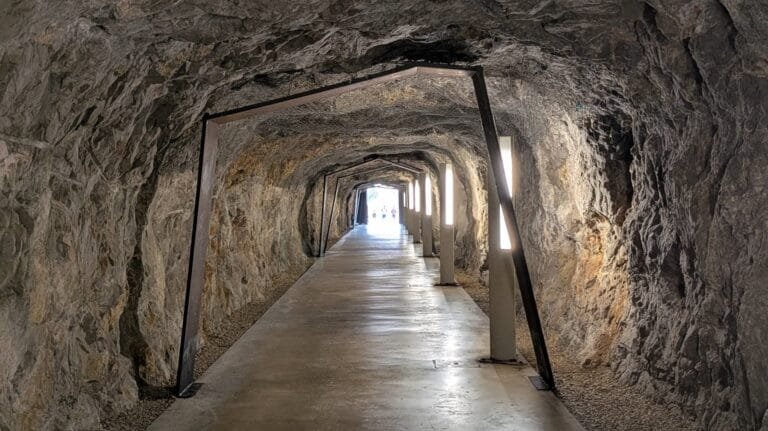

The Archaeological Museum of Dénia is one of the city’s most important cultural spaces, dedicated to preserving, studying, and sharing the local archaeological heritage. Its collection spans more than two thousand years of history, from the earliest Iberian settlements to the modern era.
The institution gathers and displays objects from various archaeological sites within the municipality of Dénia, including Iberian, Roman, Islamic, and Christian remains. Thanks to a modernised museography, the exhibition is organised chronologically, allowing visitors to understand the city’s historical evolution in a clear and educational way.
The visit is suitable for both the general public and those interested in archaeology or Mediterranean cultures. Additionally, entry to the museum is free, making it an excellent option for anyone wishing to explore Dénia’s past at no cost.
- A New Home for the Museum: The Renovated Headquarters on Calle Cavallers
- A Chronological Journey: What to See at the Archaeological Museum
- Opening Hours & Visitor Tips
- Cultural Extras: What to See Near the Museum
- Why Visiting the Archaeological Museum of Dénia Is a Must
- Keep Exploring Dénia: More Articles on PlayasDenia.es
A New Home for the Museum: The Renovated Headquarters on Calle Cavallers
Location:
Until recently, the museum was located at the top of Dénia Castle, in the Palau del Governador. However, in an effort to bring history closer to the everyday life of the city, it has been moved to a new location: the Casa de la Marquesa Valero de Palma, at Calle Cavallers, 3.
This location not only makes access easier for visitors but also provides optimal conditions for preserving the collections and for modern museography. The new headquarters is perfectly integrated into the urban environment, right in the historic district, allowing visitors to combine their visit with a stroll through Dénia’s charming streets.
As I detailed in my experience, this move has revitalised the museum’s role. Now, with more spacious areas and updated technological resources, the historical narrative is enriched, and visitors can more easily immerse themselves in the story of the past.
A Chronological Journey: What to See at the Archaeological Museum
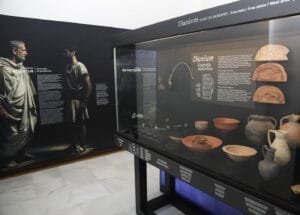
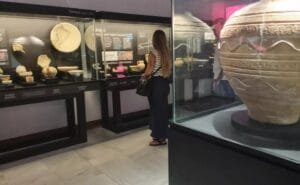
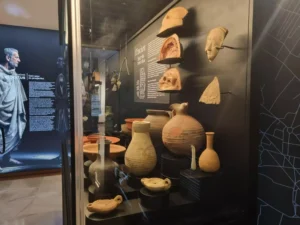
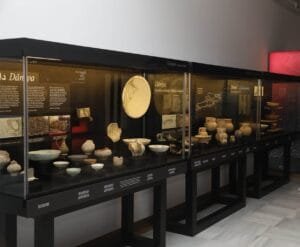
The Archaeological Museum of Dénia offers a chronological tour through its galleries, allowing visitors to clearly understand how the city’s history has unfolded from Antiquity to the Middle Ages. Always with the Mediterranean Sea as a connecting thread, the new exhibition is centred on the theme “A ciutat de mar estant”. The displayed pieces were recovered from excavations across the municipality and reflect Dénia’s strategic role as a key point in the western Mediterranean.
Below is a summary of the main periods represented in the museum:
From Alt de Benimaquia to Dianium: The Iberian and Roman Legacy
The journey begins with the earliest Iberian testimonies, notably the Alt de Benimaquia site, dated to the 6th century BC. In the museum, visitors can see domestic utensils, decorated pottery fragments, tools, and other everyday objects that reveal the lifestyle of these communities.
The transition to the Roman period is clearly showcased in the section dedicated to Dianium, the name Dénia held under the Roman Empire. This city was an important port and commercial hub. The museum preserves architectural elements, coins, maritime transport amphorae, and objects related to economic activities and daily life, reflecting Dianium’s integration into Mediterranean trade routes.
Daniya and Christian Dénia: Traces of the Middle Ages
The next chronological section is dedicated to the Middle Ages, highlighting two key periods: the Islamic era and the subsequent Christian rule.
During the 11th century, Daniya was the capital of an independent taifa and experienced notable economic and cultural prosperity. The museum displays Andalusian ceramics, ornamental pieces, and urban remains that illustrate the sophistication of this era.
After the Christian conquest in the 13th century, Dénia underwent gradual transformation. The Christian section documents this transition through domestic objects, religious items, and urban remnants. These artefacts help visitors understand how the city and its port were restructured under the new political and religious order.
Opening Hours & Visitor Tips
One of the most appealing aspects of the Archaeological Museum of Dénia is that entry is currently free, and it is open almost every day, making it an accessible cultural activity for everyone.
Opening hours Monday to Saturday:
- October to February: 10:00 to 14:00 and 16:00 to 19:00.
- March to May: 10:00 to 14:00 and 17:00 to 20:00.
- June to September: 10:00 to 13:00 and 17:00 to 21:00.
Sundays and public holidays: 09:00 to 15:00.
Closed on: 01/01, 19/03, 01/05, and 25/12.
Every Saturday at 11:30, free guided tours are offered, with no prior reservation required. This option is ideal for those wishing to gain deeper context, especially if they are not familiar with the region’s history.
I recommend dedicating at least a full hour to the visit. There is much to discover, and the galleries encourage a leisurely exploration.
Cultural Extras: What to See Near the Museum
Located in the historic centre of Dénia, visiting the archaeological museum is an excellent cultural alternative to typical summer days. Nearby, you can find other points of interest:
- Dénia Castle: Although the museum is no longer inside the castle, this monument remains a must-see. Its visit offers spectacular panoramic views and complements perfectly what you have learned at the museum.
- Toy Museum: Ideal for discovering a more recent aspect of local history, focused on the 20th-century toy industry.
- Ethnological Museum and Sea Museum: Two lesser-known museums that help complete the understanding of Dénia’s identity.
Of course, the local gastronomy cannot be overlooked. Between history and culture, nothing beats enjoying a tapa of dried octopus or a plate of arroz a banda at one of the nearby restaurants.
Why Visiting the Archaeological Museum of Dénia Is a Must
If you are in Dénia and can only choose one cultural visit, the Archaeological Museum should be at the top of your list. Not only because of the quality of its exhibition, but because it allows you to understand the soul of the city, how it has been built over the centuries, and the role it has played in the Mediterranean context.
The journey is clear, educational, and engaging for both adults and children. And since it is free and centrally located, there are no excuses. Furthermore, the move to the new headquarters has elevated the exhibition and museography, placing it on par with larger archaeological museums in the Valencian Community.
Keep Exploring Dénia: More Articles on PlayasDenia.es
Did you enjoy this guide to the Archaeological Museum of Dénia? Then don’t miss our other articles on PlayasDenia.es. Discover routes to the best beaches, guides to local gastronomy, and other articles such as:
- Dénia Castle: A Historic Gem with Breathtaking Views
- Toy Museum in Dénia: History, Nostalgia, and Family Fun
- The 5 Best Beaches in Dénia: Your Ultimate Guide to Enjoying the Mediterranean
And if you found this content useful, share it on your social networks! Help more travellers discover Dénia’s hidden gems and plan an unforgettable cultural visit.
Related articles:
The best restaurants in Denia in 2026: where to eat very well this year
DNA Gastronomic Festival 2025 in Dénia: 10 Years of Creativity by the Mediterranean
The Sea Museum in Dénia: A Must-See Spot in the City’s Harbour
The Ethnological Museum of Dénia: A Cultural Treasure Worth Discovering
Toy Museum in Dénia: History, nostalgia and family fun